
Projects
I aim to help others be better tomorrow by implementing communication theories to improve the way we train and develop staff. My career deliverables have reflected that commitment.
Process Improvement
The Safety Audit/Data Analysis Program has been a crucial initiative within University Health for many years, aimed at ensuring workplace safety through effective data collection and analysis. Historically, multiple data collection systems were piloted, yet when Saeed became Safety Manager, the process relied heavily on a content management system (CMS) that proved inadequate, resulting in a dual reliance on Excel for tracking. This inefficiency consumed much of the safety staff’s time in gathering, organizing, and reporting data.
Recognizing these challenges, Saeed posed a pivotal question: “Is there a better way?” This inquiry opened the door for me to engage deeply with Saeed and the safety team, gaining insights into their frustrations and aspirations for an improved tracking system, particularly in monitoring non-compliance durations.
Utilizing my Excel skills, I undertook a comprehensive update of their tracking log. However, I soon faced a significant challenge: the standard Excel formulas did not accurately reflect the data needed for effective reporting. Drawing on my understanding of communication theory, particularly the concept of message construction, I tailored specific equations to align with Saeed’s objectives. This approach exemplifies how effective communication involves not just transmitting information but understanding the underlying message and adapting it to meet the audience’s needs.
Furthermore, I recognized the importance of visual communication in data interpretation. I revamped the aesthetics and interactivity of the Safety Audit/Data Analysis Program, enhancing user experience and facilitating better data management. This aligns with the principle of organizational communication, which emphasizes that communication is not merely about messages but also about the processes and systems that shape organizational culture.
The previous method of data collection communicated a narrow focus on identifying deficiencies. By redesigning the data tracking and analysis system to be more automated and interactive (as demonstrated in the accompanying video), we shifted the safety team’s focus towards resolving issues rather than merely cataloging them. This proactive approach has yielded two significant outcomes. First, through actions rather than words, safety has successfully conveyed its commitment to enhancing the work environment. This transformation reflects the constitutive view of communication, where organizational identity is shaped through collective action.
Second, as safety became more effective in addressing issues, the Experience Modification Factor (e-mod)—a critical metric for workplace injuries and workers’ compensation premiums—showed remarkable improvement. University Health’s e-mod, which began at an already impressive 0.46, decreased to 0.44 following the implementation of the new Safety Audit/Data Analysis Program. While this may seem modest, it translates to substantial financial savings, equating to millions in reduced premiums for an organization of this size.
In summary, my contributions to the Safety Audit/Data Analysis Program not only streamlined data collection processes but also exemplified the importance of effective communication strategies. By actively listening to stakeholder concerns, researching innovative solutions, and employing Excel to create an engaging user interface, I successfully transformed the program into a tool that enhances safety outcomes and organizational effectiveness.
“Don’t look for the big, quick improvement. Seek the small improvement one day at a time. That’s the only way it happens. When it happens, it lasts.”
– John Wooden
Data Tracking
Effective data tracking is essential for guiding organizational decision-making, particularly in Emergency Management, where timely and accurate incident response is critical. Traditionally, the Emergency Management team devoted the entire month of December to compile incident reports, categorize types of incidents, and prepare for annual accreditation. This labor-intensive process not only consumed valuable time but also raised questions about the utility of the data being collected. What insights could be derived from this data, and how could it inform improvements in response strategies?
Recognizing the opportunity for enhancement, I decided to apply the successful strategies I implemented with the Safety Audit/Data Analysis Program to Emergency Management’s incident reporting process. I began by actively listening to the senior managers’ challenges in compiling and analyzing accurate data. Through collaborative discussions, we identified key categories that would provide meaningful insights for their reporting needs.
Leveraging my advanced Excel skills, I developed an automated tracking system that streamlined the entire process. Emergency Management personnel can now log incidents and attach relevant reports, with the system automatically calculating, sorting, and presenting the data. This shift from manual compilation to automation not only saves time but also enhances the clarity and accessibility of the information.
A key takeaway from my communication studies has been the profound impact of visual communication on data interpretation. In developing this tracking system, I focused on creating a user-friendly interface that presents complex data in a visually digestible format. This project was particularly challenging due to the volume of information required by the senior managers. However, I used my expertise in visual communication to transform dense data into clear, actionable insights.
To ensure the system met the needs of Emergency Management, I dedicated significant time to researching advanced Excel functionalities, enabling me to write custom programs that enhance the user experience. As a result, Emergency Management can now access real-time data at a moment’s notice, eliminating the need for the month-long December compilation.
This improvement has not only freed up time for the team to focus on other critical projects but also fosters a culture of proactive data utilization. By understanding the importance of data tracking beyond mere compliance for annual accreditation, the Emergency Management team can now engage in meaningful discussions about response strategies and areas for improvement.
In summary, my work in redesigning the incident reporting process has underscored the vital role of effective communication in data management. By listening to stakeholders, applying my technical skills, and prioritizing visual clarity, I have empowered the Emergency Management team to make data-driven decisions that enhance their operational efficiency.
“Data are just summaries of thousands of stories – tell a few of those stories to help make the data meaningful.”
– Dan Heath
Training Material
The COVID-19 pandemic significantly transformed the landscape of teaching and training, necessitating a shift towards online learning modules. Within this context, the Hazmat Program for a Level 1 Trauma Center plays a critical role in ensuring that Emergency Room staff are equipped to provide care during hazardous materials incidents. My initial role involved instructing in-person classes, but as I progressed through my Bachelor of Communication, I recognized the importance of adapting training methodologies to enhance retention and comprehension.
Understanding that effective training is not merely about transmitting information, I sought to create a more engaging and responsive program. The challenges of a post-COVID environment—staffing shortages, burnout, and limited time for training—prompted the Associate Executive Director of Emergency Management, my boss, to implement Mach-5 training videos. The objective of these videos is to deliver concise, topic-specific training in five minutes or less, facilitating both individual and team learning that can be incorporated into monthly unit or departmental meetings.
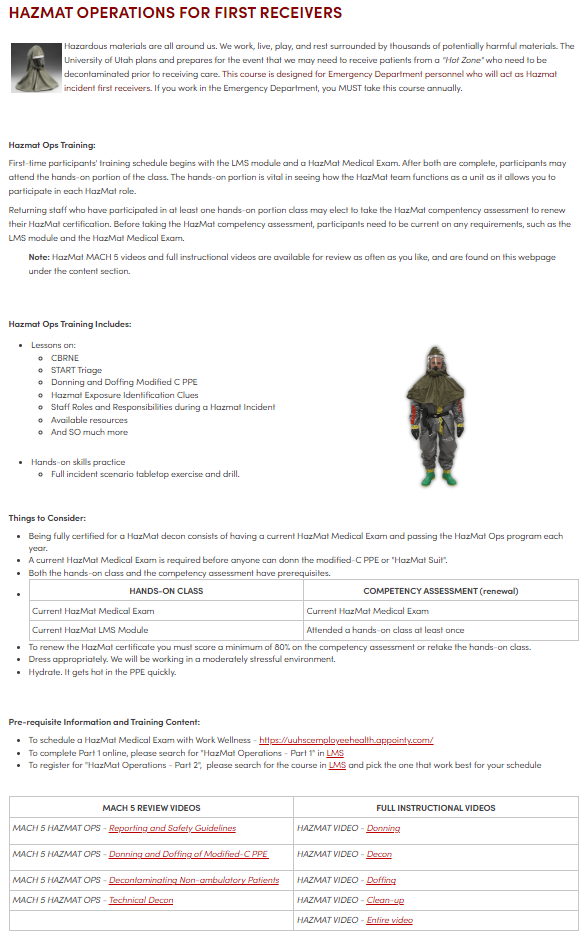
As I was redesigning the Hazmat Program, I proposed to my boss the creation of several Mach-5 videos focused on hazmat training. This involved developing content using PowerPoint and recording voiceovers for my presentations, which were then exported as MP4 files. To further enhance accessibility and facilitate ongoing learning, I created a dedicated webpage for the Hazmat Program, housing the collection of Mach-5 videos (as shown to the right). This resource allows staff to engage with training materials at their convenience, thus accommodating their busy schedules.
Throughout this process, I applied key principles of learning theory, which emphasizes that when learners are empowered to guide their own learning experiences, retention and understanding are significantly improved. The effectiveness of this approach was demonstrated by a noticeable reduction in injuries and improper responses to hazmat situations among the Emergency Room staff.
The creation of Mach-5 videos not only streamlined the training process but also fostered a culture of continuous improvement and proactive learning. Below are two example videos of the Mach-5 series on HazMat Operations that I developed using my boss’s template.
In summary, my contributions to the redesign of the Hazmat Training Program exemplify the intersection of communication theory and practical training methodologies. By leveraging technology, understanding learner needs, and fostering a flexible learning environment, I successfully enhanced the effectiveness of hazmat training for Emergency Room staff.
“Tell me and I forget. Teach me and I remember. Involve me and I learn.”
– Philosopher Xun Kuang
 E-Portfolio